
A website can attract visitors through SEO, social media, paid campaigns, and referrals without generating the enquiries the business expects. The marketing team sees traffic increasing, but the sales pipeline remains quiet. The immediate response is often to publish more content, expand advertising, or invest in additional acquisition channels.
Before increasing that investment, there is another question worth asking: what happens after visitors arrive?
For SaaS founders and marketing leaders, traffic is only one part of the growth equation. Visitors need to recognize that a product addresses their problem, understand why the solution is relevant, find enough evidence to trust the business, and know what to do next.
When that journey breaks down, more traffic may simply send more people through the same ineffective experience.
The solution is not always to redesign the entire website or add more calls to action. It is to identify where the journey stops making sense and fix the specific problem preventing visitors from moving forward.
Traffic Is an Input, Not a Business Outcome
Website traffic measures visits, not buying intent or commercial value.
Someone searching for an explanation of a SaaS concept may visit a blog to learn. Another visitor may be comparing providers. A third may already be looking for a partner to solve a specific business problem.
These visitors have different expectations. Sending all of them to the same generic page and presenting the same immediate sales request ignores those differences.
Imagine a product design agency attracting visitors through an article about improving SaaS onboarding. A reader who is researching onboarding principles may not be ready to request a consultation. However, if the article explains a practical diagnostic approach and provides a relevant next step, the reader can move from learning toward evaluating professional support.
The important distinction is between attracting visitors and helping the right visitors progress.
Before investing in more acquisition, determine whether the existing traffic matches the intended audience, whether the landing page fulfills the visitor’s expectation, and whether the next step fits their level of interest.
Find Out Where the Conversion Path Breaks
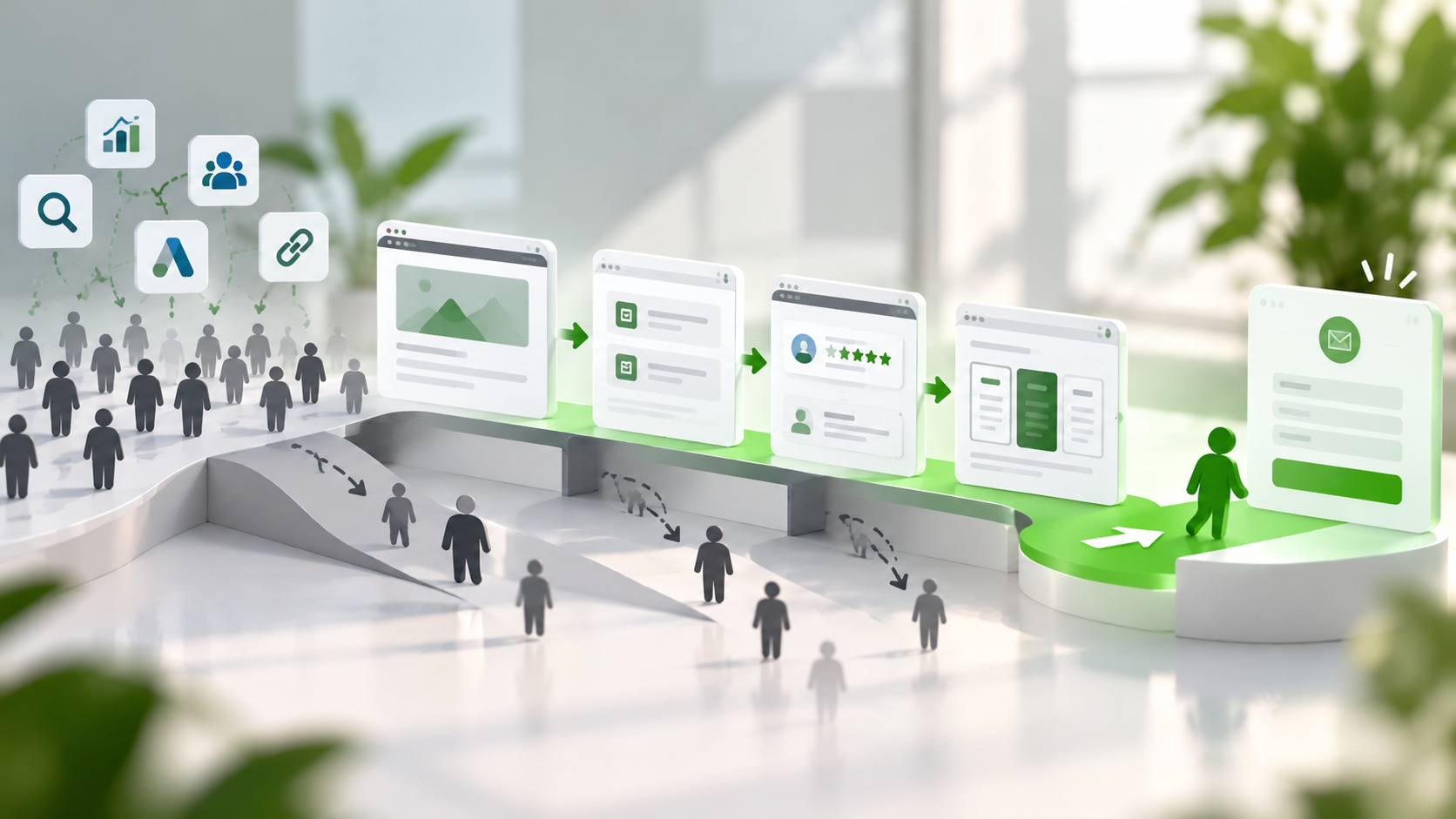
A conversion path is the sequence of experiences that helps a visitor move from initial interest toward a meaningful action, such as requesting a consultation, booking a demo, or submitting an enquiry.
That path may include a search result, a blog article, a service page, a case study, a pricing page, and a contact form. Not every visitor needs every step, but each transition should have a clear purpose.
Start by examining the journey in stages.
- Acquisition: Are visitors arriving from relevant search queries, campaigns, and referral sources?
- Relevance: Does the landing page address the problem that motivated the visit?
- Understanding: Can visitors explain what the business offers, who it serves, and why it may be suitable for them?
- Confidence: Is there credible evidence to help visitors assess the provider’s expertise and suitability?
- Action: Is the next step clear, appropriate, and straightforward to complete?
Look for the stage where evidence suggests the journey is breaking down. If relevant visitors arrive but leave without engaging, investigate the page’s relevance and clarity. If visitors explore service pages but do not enquire, examine the offer, proof, decision barriers, and contact experience.
Do not assume that every exit represents a design failure. Some visitors will leave because they are researching, are not qualified prospects, or are not ready to buy. The objective is to identify avoidable friction among the audience the business actually wants to reach.
Four Reasons Visitors May Not Become Enquiries
1. The Page Does Not Match the Visitor’s Intent
A visitor clicks a search result expecting to understand a specific problem but lands on a page dominated by general company messaging. The business may offer a relevant service, yet the page does not immediately connect that service to the visitor’s need.
This mismatch can occur between search queries and landing pages, advertisements and headlines, or blog content and the next recommended action.
Review the source of each important traffic segment and compare the visitor’s likely intent with the page they reach. If the promise made before the click differs from the experience afterward, fix that disconnect before changing the visual design.
2. The Value Proposition Is Difficult to Understand
A website may describe its services accurately while leaving prospective customers unsure why those services matter to them.
Phrases such as “innovative digital solutions” or “end-to-end transformation” communicate little about the specific problem being addressed.
A stronger value proposition explains the audience, the problem, and the relevant outcome in language the audience understands. Supporting content should then explain how the business approaches the problem and what the prospective customer can reasonably expect.
Clarity is not about making every page shorter. It is about helping visitors understand what is relevant without forcing them to interpret vague claims.
3. The Website Has Not Earned Enough Trust
A visitor considering a substantial service engagement needs more than a persuasive headline.
They may want to understand the team’s expertise, how the work is approached, whether the provider understands their industry, and what evidence supports its claims.
Relevant case studies, named experts, transparent processes, detailed service explanations, and verifiable testimonials can help answer these questions when they genuinely exist.
Do not manufacture proof or rely on unsupported promises. If the business lacks published case studies, it can still demonstrate expertise through useful explanations, clearly documented methods, and honest descriptions of its work.
Trust should develop throughout the visitor journey, not appear as a collection of logos at the bottom of the homepage.
4. The Next Step Creates Unnecessary Friction
Visitors may understand the offer and still hesitate when the next step is unclear.
A button labelled “Get Started” does not explain whether the visitor will book a meeting, create an account, or submit a sales enquiry. A long contact form may request information that is unnecessary for the initial conversation.
Make the action specific and explain what happens after it. Ask only for information needed at that stage, ensure the form works correctly on mobile devices, and remove unnecessary steps.
The right conversion action also depends on intent. A reader exploring a problem may benefit from a relevant guide or service explanation, while a prospect actively evaluating providers may be ready to request a consultation.
Diagnose Before You Spend More on Acquisition
When a website underperforms, changing several things at once makes it difficult to understand what caused the problem.
Instead, build a diagnosis using available evidence.
Start by checking analytics by traffic source, landing page, device, and conversion event. Confirm that tracking is working before interpreting an apparent lack of enquiries. Then inspect the path visitors take through the website and identify where meaningful engagement declines.
Combine this quantitative evidence with qualitative investigation. Review search queries, read relevant support or sales conversations, observe users navigating key pages, and ask prospective customers what information they needed before making a decision.
For example, if visitors reach a service page but rarely proceed to the contact page, the next step is not automatically to add another button. Investigate whether the service is clearly explained, whether visitors can assess its relevance, and whether they have enough evidence to consider an enquiry.
This approach helps distinguish between a traffic-quality problem, a messaging problem, a trust gap, and a usability issue. Each requires a different response.
Build a Conversion Path Around the Customer’s Decision
A useful conversion path connects the information visitors need with the decision they are trying to make.
For an informational blog, the next step might be a related article that helps the reader diagnose their problem. For someone comparing solutions, it could be a detailed service page that explains the approach, scope, and relevant expertise. For a prospect ready to engage, a clear enquiry or consultation option may be appropriate.
At YesOrYes, the goal is to connect digital experiences with the needs of the people using them. The same principle applies to a business website: every important page should help visitors understand something relevant or take a useful next step.
Review your website as a connected journey rather than a collection of individual pages. Check whether blog articles lead to relevant resources, service pages answer important evaluation questions, and calls to action match the visitor’s level of intent.
Measure Whether the Changes Improve Business Outcomes
Once a problem has been identified, make a focused change and define how its impact will be evaluated.
Track relevant measures such as qualified enquiry rate, service-page progression, contact-form completion, and conversions by traffic source. Where possible, assess lead quality as well as enquiry volume.
A higher conversion rate is not automatically a better business outcome if the additional enquiries are irrelevant. Likewise, a page that attracts fewer visitors may still contribute more value if it reaches a better-qualified audience.
Use the evidence to decide what to improve next. If the problem remains unclear, conduct further research rather than repeatedly changing headlines, buttons, and layouts without a clear hypothesis.
For businesses evaluating their website experience, YesOrYes product design and development services offer a relevant starting point for exploring how user-centered design can support clearer digital journeys.
More Traffic Cannot Fix a Broken Journey
Acquisition matters, but it works best when the website gives relevant visitors a clear reason to continue.
Before increasing traffic spend, understand who is arriving, what they expect, where they hesitate, and what evidence they need to take the next step. Then address the most important barrier and measure the result.
If your website attracts the right audience but struggles to turn that interest into meaningful enquiries, contact YesOrYes to discuss your website and user experience challenges.
Growth does not always begin with reaching more people. Sometimes it begins by helping the people already arriving understand the value you offer and move confidently toward a decision.